
Reading time: 5 min
by Alberto Aleo.
The Sales Playbook or Sales Enablement Manual is every sales director’s white whale. Every sales leader has, at least once, wished they could create a flawless procedure, an algorithm, or an (almost) mathematical sequence that, if followed to the letter, would guarantee success in every negotiation. Is it actually possible for something like this to exist?
Does it make sense to design a Sales Enablement Manual or Sales Playbook and enforce its use among your sales force?
What is a Sales Playbook and what is it for?
Some time ago, I wrote an article called “The Seller’s Suitcase,” in which I described one of my first work experiences. As a newly hired employee at a well-known Italian automotive company, I was asked to shadow sales reps to find out what they had in their bags, at which stages of the negotiation they used the materials provided by the company, and whether anything was missing in terms of marketing and communication tools that could help them be more effective. What emerged was an analysis of negotiation stages, which, as I discovered back then, did indeed follow a precise procedure, at least when carried out by the most experienced reps. Company tools played a crucial role, becoming actual “stage props” that the top performers knew how to summon just at the right moment. Fleshing out my notes gave birth to a Sales Playbook: a tool that wouldn’t guarantee a sale every single time, but one that is immensely useful for mapping out customer approach methods and suggesting how to use marketing tools, communication assets, and sales techniques across the various stages of the relationship.
Spontaneity vs Method.
Having established that a Sales Playbook is not a pipe dream but a tool to guide our interactions with customers, some might wonder whether creating one and enforcing its use might cause reps to lose their spontaneity, make their relationships more mechanical and, ultimately, be detrimental to their success. To dispel this doubt, we need to bust two myths: one regarding spontaneity and another regarding method.
Spontaneity is an ideal concept that, in reality, often falls short. At the end of the day, no one is ever truly spontaneous. Whether we like it or not, we all act based on our experiences, biases, and beliefs that have led us to develop our own “behavioural scripts.” Deliberately reflecting on the stages of customer relationships, as one would do when designing a Sales Playbook, can actually restore our freedom of choice, allowing us to catch ourselves while making mistakes, break our engrained habits, or update outdated behavioural patterns.
Having a method does not necessarily mean being strict or blindly following rules.
A method is what allows you to plan the path toward achieving your goals, backtrack if you’ve made a mistake, learn from failures, and replicate successes.
It leaves room for personalisation and adaptations based on our customers’ style and character. Rules and methods are therefore not synonymous; knowing the stages of customer relationships and the best tools to guide them does not force conformity, but rather stimulates structured creativity operating within a process.
How to design a Sales Playbook.
If I’ve persuaded you that you need to design your sales manual, it’s now time to understand how to go about it. Although observing your sales reps is the best possible approach, there are a few shortcuts that can help. First and foremost, you will need to break the customer relationship down into stages, and here we suggest drawing inspiration from our Circle of Trust, which describes them precisely.
Once you’ve mapped out the various steps, gather a list of all the marketing and communication tools, both physical and digital, that the company has at its disposal to win the customer over. These can also be described as Touchpoints, or interfaces through which the customer experiences your brand. For instance, a website, an event, a brochure, or even a retail location are all touchpoints, each welcoming and presenting a portion of the value you can offer. They must be activated at a precise moment, neither too early nor too late, to express their full effectiveness.

Next, draft a matrix where you cross-reference the stages with the tools that are most useful at that exact moment. You will discover that certain tools are better suited for pre-sale stages (designed to help the customer get comfortable and gather information, such as a company tour or a well-crafted brochure), others are built specifically for the core sales phase (a clear, transparent price list alongside well-drafted purchase contracts), and still others are dedicated to post-sale stages (warranty plans, a list of authorised service centres, etc.).
Designing the sequence of instances in which to present these tools means controlling and guiding the customer experience and their decision-making process.
Designing new elements for the Sales Playbook.
Analysing stages and the tools you have available might reveal that something is missing. In that case, you should design and add a new tool, or even a new stage in the customer relationship, to your Sales Playbook. But how do you know if that is necessary?
While carrying out the analysis as described above, keep asking yourself these questions:
- What is the goal of this particular stage of the relationship?
- What obstacles might the customer and the sales rep run into while pursuing that goal?
- What can we do and how can we do it to make things easier for them?
The answers will help you refine your approach and spark new ideas.
In conclusion, while it’s true that there are no foolproof algorithms for sales, having a method and the right tools makes a world of difference, restoring professionalism to your sales team and reassuring your clients. The manual to follow so you don’t just rely on winging it is the Sales Playbook. Try drafting one, incorporating best practices as well as mistakes to avoid: it will become your compass and an invaluable practical companion for the whole team!
| partem claram semper aspice |
The photos used - where not owned by the editorial team or our guests - are purchased on Adobe Stock and IStockPhoto or downloaded from platforms such as UnSplash or Pexels.
Did you like this post and want to learn more about the topics?
Passodue research on issues related to sales, marketing, ethics and the centrality of human beings within the market logic, officially started in 2012. The results derived from our work are described in the publications and in the books you can find in this section.
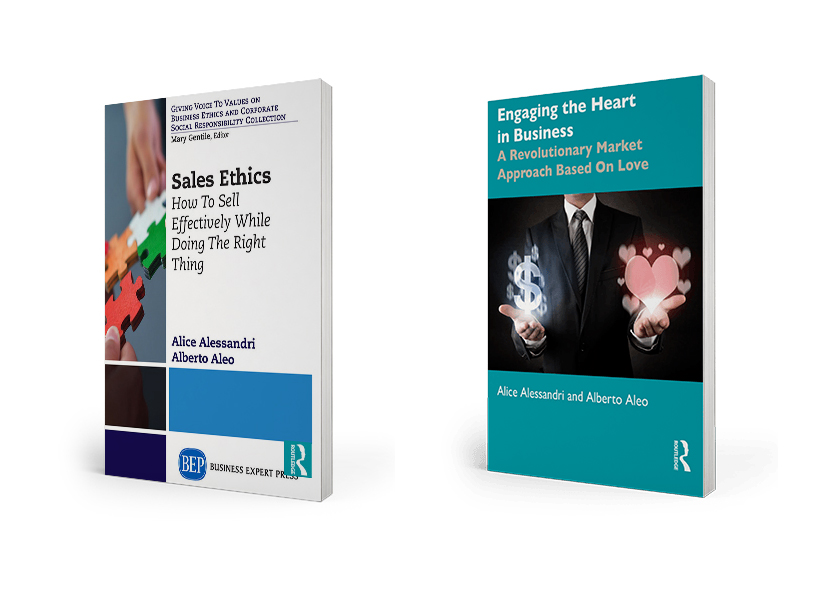
Click below to find out Passodue's books.
You're probably interested also in...




Comments (0)